.svg)


We’re told to stay put. To limit air travel. To reduce carbon footprints. And on paper, it makes sense – why would relocating someone across the world be good for the planet? How could relocation possibly align with sustainability goals? That’s exactly the opportunity Global Mobility teams are uniquely positioned to unlock: the potential to make relocation part of the solution, not the problem.
In many ways, relocation is the Electric Vehicle (EV) of HR relocation strategy. It comes with an upfront environmental cost—just like an EV’s battery production. And yet, as with EVs, the payoff comes later. Once a battery-powered car hits the road, the emissions begin to even out. The longer it drives, especially in countries with green energy, the cleaner it becomes compared to traditional cars. The real impact starts after the move. The same logic applies to relocating talent. If the move encourages the assignee to adopt a more sustainable lifestyle, the everyday emissions will decrease. When someone moves, everything changes: their habits, their home, their choices. And in that disruption lies a unique opportunity to reset their environmental impact for the better.
We know from behavioral psychology that life events – whether joyful or challenging – disrupt our routines and leave space to establish new ones. This psychological window, known as habit discontinuity, has been extensively studied by Professor Bas Verplanken. His studies show that people are more open to adopting new behaviors after major life changes. For Global Mobility, this insight is critical. It reframes relocation not as an emissions-heavy task, but as a driver for sustainable transformation. To read more about Verplanken’s study and what it means for the relocation industry read more here.
If thoughtfully designed, a relocation can lead to greener choices that persist well beyond the assignment. However, unlocking this potential doesn’t happen by chance—it requires intentional design. To achieve this, it is crucial to:
Policies are the backbone of company strategy. Instead of treating sustainability as an afterthought, it should be included from the beginning. Policies should be simple and effective, so it is easy to change into real action. For a practical, step-by-step approach to integrating ESG goals into your policy design, check out [this article].
The sustainability training needs to be tailored to each destination. This topic is explored more deeply in [this article]. Help assignees understand local energy systems, public transport, waste practices, and cultural expectations. It’s in these everyday decisions that the true potential lies.
Relocation Management Companies (RMCs) can make or break a sustainable move. Choose partners who prioritize sustainable suppliers, encourage green housing, and offer sustainable transportation.
Together, these three strategies form the foundation of a sustainable relocation approach. By embedding sustainability into policies, empowering employees through tailored training, and collaborating with responsible RMCs, companies can transform relocation from a logistical task into an event with lasting environmental impact.
Let’s make this tangible. A Tesla Model 3, when manufactured, produces more CO₂ than a Toyota Corolla. But once it hits the road – especially in countries like Norway, Iceland, Costa Rica, Uruguay, and New Zealand (1), where the majority of electricity is powered by renewable energy – its daily emissions are so low that it eventually breaks even and becomes the greener option. In the U.S., that breakeven point comes around 13,500 miles. In Norway? Thanks to hydroelectric power, it’s just 8,400 miles. Relocation works the same way. There’s an initial carbon cost – but what happens after is where the real impact lies.
Imagine, during a two-year international assignment, an employee is relocated from the US to the UK. Their household goods are shipped overseas in a 40-foot container—an essential part of the move that emits around 4.1 metric tons of CO₂ round-trip. While living abroad, the employee drives an average of 12,000 miles per year. If they were to choose a typical gasoline car (averaging 29.4 mpg), they’d generate roughly 7.5 tons of CO₂ over the course of their assignment—nearly doubling the environmental impact of the relocation itself.
But here’s where a single decision makes a difference. If instead they opt for an electric vehicle (consuming roughly 17 kWh per 100 km), their emissions could drop by as much as 5.8 tons of CO₂e (2). In fact, the emissions avoided by switching to an EV already surpassed those initially emitted from the 40-foot container. And in regions where clean energy powers the grid, the climate benefit of driving electric only grows. A seemingly small choice – like how you drive – can have a bigger environmental effect than the relocation itself. And that’s just the commute. Imagine the potential impact of dozens of conscious choices made throughout the assignment.
While there’s an initial carbon cost for relocation, if the move is backed by sustainable policy, tailored training, eco-focused RMC support with vetted, sustainable suppliers, it can lead to lasting behavioral shifts, like using public transit, living in energy-efficient housing, and reducing waste. Over time, assignees’ overall emissions may drop well below what they would’ve produced by staying put.
And beyond that, there’s a deeper, long-term opportunity. When viewing relocation holistically; as a full assignment cycle rather than a one-time event, the impact can extend far beyond the duration of the move. With the right support, people can adopt more sustainable habits during their time abroad, and when they repatriate, there’s a strong chance they bring those habits back with them. Sustainability becomes part of their mindset, meaning that it’s not just a temporary shift, but a chance to spark a lifelong change in mindset and lifestyle.
So, is it better to relocate, or not to relocate? Having seen the numbers, – there is no doubt! Yes, relocation can be the better choice. With the right mindset and strategy, relocation can have a powerful impact on sustainability. Relocating talent can become the better, more sustainable option.
This is the moment for the Global Mobility industry to lead. To make every move count. To rethink what it means to move—not just people, but ideas. Not just positions, but values.
Because when you relocate someone with purpose, you’re not just changing their address.
And helping shape a more sustainable world.
As we wrap up our White Paper 2.0 series, one thing is clear: sustainability in Global Mobility is no longer a single initiative, policy, or training. It’s a mindset shift – a commitment to creating mobility experiences that move people and pave the way for a more sustainable future. We’ve explored how policies, behavioral insights, training, pre-approved relocation packages, and responsible partnerships can create lasting environmental change.
But the conversation doesn’t end here.
In the coming weeks and months, we’ll continue to share fresh insights, practical tools, and deeper dives into the topics that matter most. So stay tuned—there’s much more ahead.
Because sustainability isn’t just a goal for the future. With the right tools, it can be part of every move we make – starting now.
Thank you for reading. Let’s keep driving forward.
Sources:
1 Climate Council. (2022, August 15). 11 countries leading the charge on renewable energy. https://www.climatecouncil.org.au/11-countries-leading-the-charge-on-renewable-energy/
2 White Paper 1.0 – Driving Sustainability: The Case for Eco-Friendly Assignment in Global Mobility
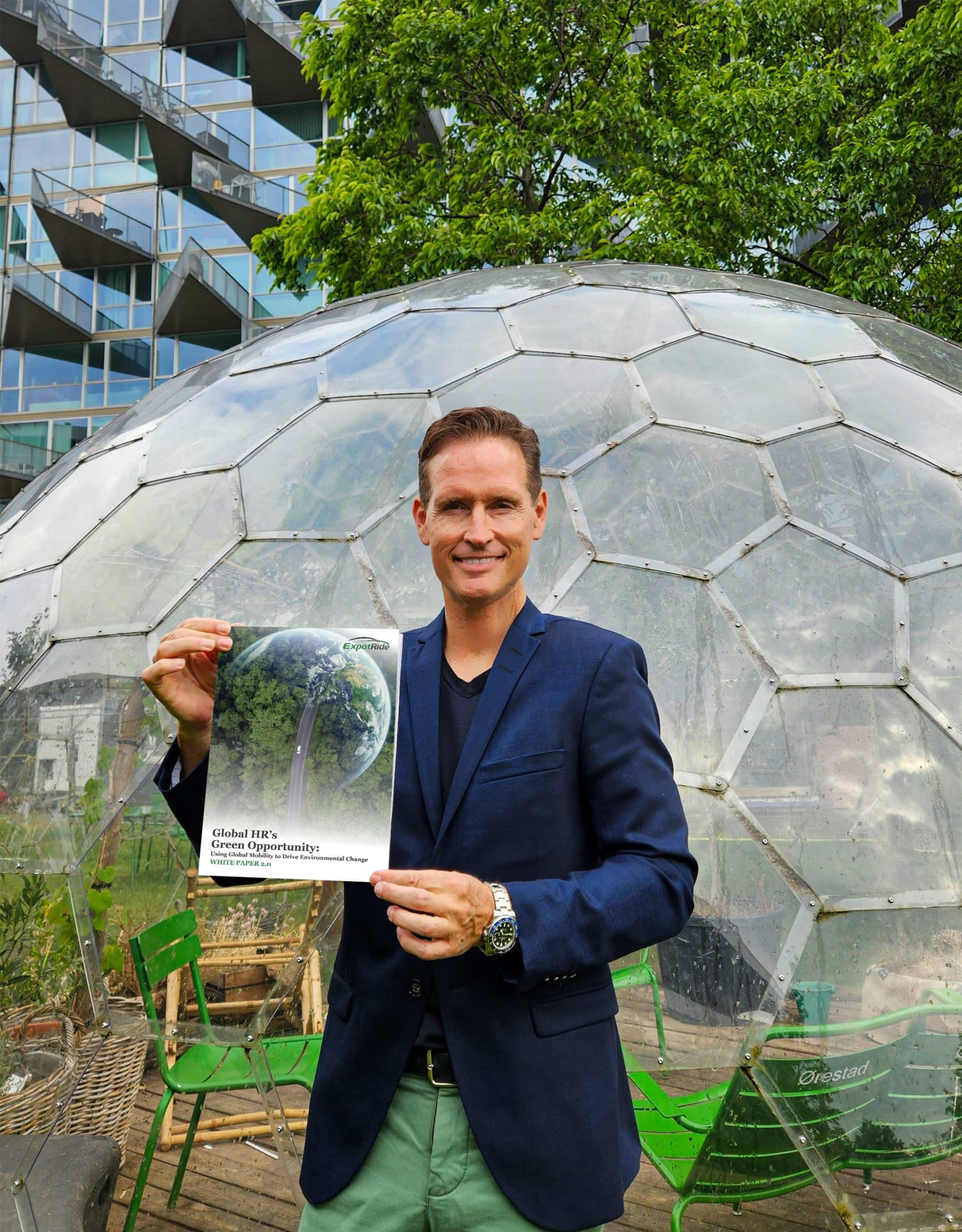
3 White Paper 2.0 – Global HR’s Green Opportunity: Using Global Mobility to Drive Environmental Change
Image credits:
1. Photo by alenkadr on Unsplash
2.Created by AI Freepik
.svg)


