.svg)


The movement of people across borders, whether for international assignments or corporate relocations, carries environmental implications, from carbon emissions linked to travel to the adaptation of sustainable practices in a new country. Integrating sustainability into cultural awareness training ensures that employees not only develop the cultural competence needed for their new roles but also adopt responsible practices that align with corporate sustainability goals.
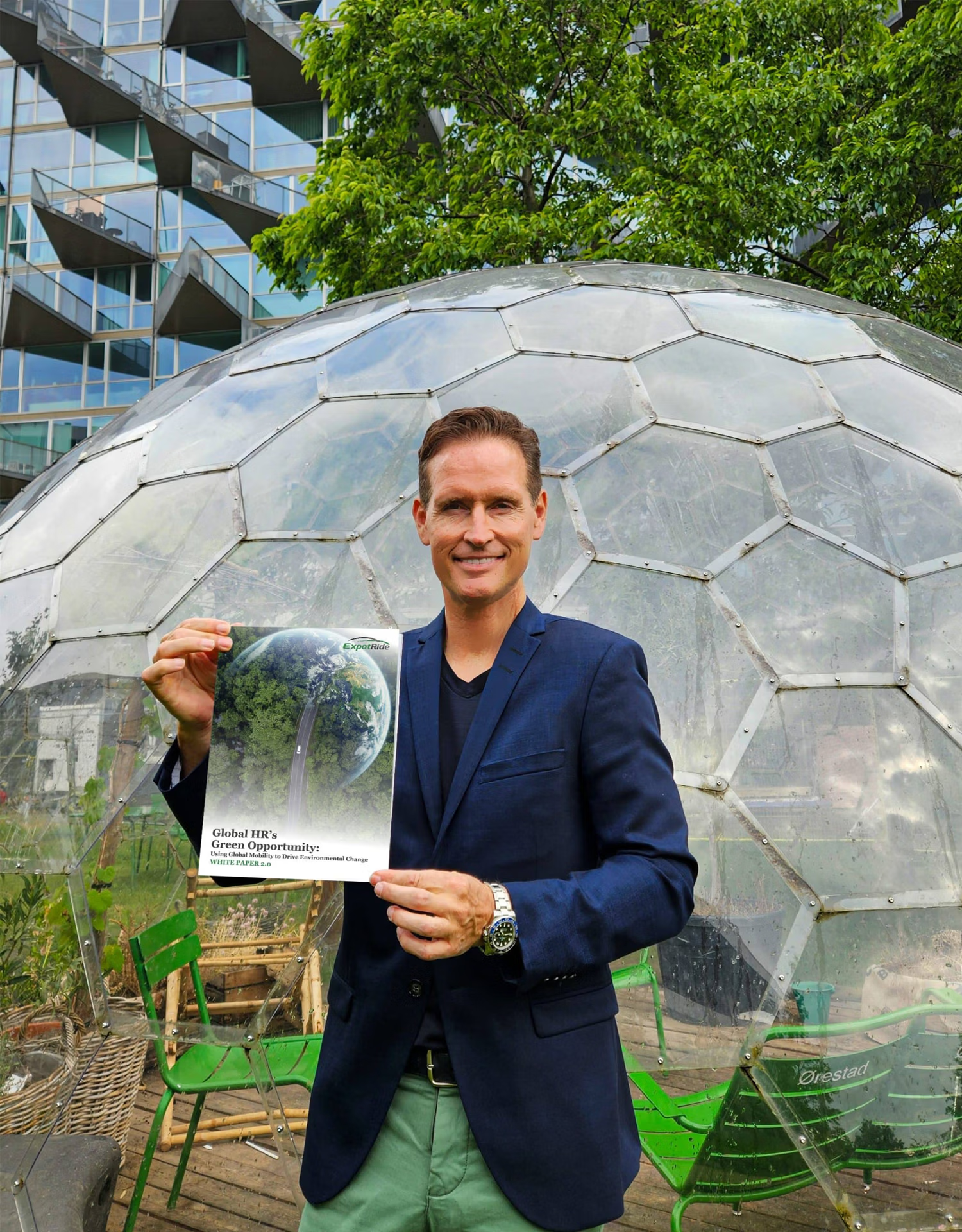
In this interview, Stefan Remhof, managing partner of the People Mobility Alliance and Professor of International Management at IU International University, sheds light on why sustainability should be a core component of cultural awareness training. He talks more about the relocation as an opportunity for driving meaningful change and expands on the topic which we cooperated on in the ExpatRide’s WhitePaper 2.0 Global HR’s Green Opportunity: Using Global Mobility to Drive Environmental Change. Enjoy the video or transcript below!
One of the experts we draw upon in the WhitePaper is you, Stefan, could you introduce yourself?
I’m Stefan, managing partner of the People Mobility Alliance, and have a background as professor in international management.
Why is necessary to incorporate sustainability into cultural awareness training? Thank you for inviting me. First, I’d like to acknowledge my colleague, Alexia Schmolling, for her contributions to the White Paper. And to answer your question: There is in general an increasing awareness about sustainability in all the companies. All the investors are going beyond the aim of decreasing carbon emission. I would be surprised if sustainability wouldn’t be included in expat or global mobility movements, because there is an impact to be made. Once you send people abroad, you have to move them in terms of flights and transportation, so there are carbon emissions. We need to raise the awareness both on the employee side, the employer side, as well as on the organization side. We need to try to reduce the carbon footprint. We need to raise awareness and show how important the topic of sustainability is.
When we want to raise awareness about sustainability, what components would you say are important to consider?
Guidelines and policies will be one part of the story. However, I think guidelines aren’t worth the paper it’s written on, if you don’t offer any trainings or awareness trainings on sustainability. These trainings should be for the employees and the whole organisation. It’s a combination of both, incorporating policies within the company organization, and awareness trainings for the employees and for the executive level.
What role do you think these awareness trainings play in promoting sustainability in relocation? I think it’s combining both worlds. Combining relocation and international assignments on one side, and sustainability on the other. Relocation is necessary for the company to increase its presence and international operations, and understanding how to connect that with sustainability issues and goals of the company. It’s a sort of holistic approach.
Is it only for international assignees, or do you see a broader use for these awareness programs? Relocation programs primarily target international assignees, but in the end, it is necessary to integrate it into the organizational culture. I think, all the executives, the management, and leaders within an organization play a crucial role, by acting as ‘role models’. By being a good example for how to create a sustainable culture within a company. It’s two sides of a coin.
What are some of the key challenges that people face in terms of relocations and sustainability? And how do you think this training can help? It’s the effort, it’s financially, it’s time, these are some of the challenges. During a relocation, time is a scarce resource, so it is necessary to prepare. To prepare your people, your employees and increase their awareness of sustainability. It might seem of minor importance at first glance, but in the end, it’s of big importance, and therefore, the earlier you start with the sustainability training and awareness training, the better off everyone is.
So it is necessary to prepare assignees well in advance and support them throughout the relocation, as well as after their return? Exactly. As you just mentioned, it’s a continuous training. Meaning it’s not a once in a lifetime training, where it’s done and then you get your certificate. No, you have to learn, reflect and repeat, – and maybe even refresh the knowledge. Both the knowledge and the circumstances might change. Therefore, our approach is continuous learning, – you might even call it lifelong learning.
How can we then ensure that these programs are tailored to both the assignee and also to the specific location? Sustainability is dependent on a specific location. But to mention it again, it is vert important that the organization and the leaders within the organization, are being good role models and showing a good example, by for example allocating resources for training, in terms of when to realize the training, the payment of the trainings and so on. I think it is dependent on the destination, and the training might even adapt to special circumstances or special environment. There is a difference between going to the US, and going to Mexico, two different countries with two different circumstances. So it’s not a One-Size-Fits-All-Solution in terms of training, it’s more adapted training considering the circumstances within the different destinations or host countries.
Can you tell us more about how sustainability and cultural awareness training actually offer benefits for both the organization, but also the individuals involved?
I think sustainability and cultural awareness are really connected. Cultural awareness is about preparing yourself in terms of living and working abroad. That’s very interesting because this is where you have to leave your comfort zone. But once you live and work in a different country, it is necessary for both you and your significant others to adapt – to adapt your behaviors and mindset, – also to a different way of sustainability. It is possible that the circumstances are different to your home country, for example in terms of waste management or driving electric cars. That’s why I think there’s connection between both aspects. On one side, you have the sustainability within the cultural awareness training, or you have the cultural awareness within the sustainability training. So it’s like one way or the other. It’s completely interconnected. If you increase the culture awareness of your employees, but leave out sustainability, or increase sustainability but leave out cultural awareness, then it would be like covering one aspect without covering the other.
What trends do you foresee in the future regarding sustainability, and how do you think companies should prepare for them? I think one trend that might force organizations to react is stronger regulation. For example on the level of the European Union or other industrialized countries. Either companies can choose to react, or they can be proactive and design and help form the regulation. By doing so, they will be drivers of the regulation, drivers of change. The earlier they start, and now I am repeating myself, the earlier the companies and the employees start increasing the sustainability within their organization, within their processes, and within their relocation programs, the better the results are in the end. That way they also won’t need to react on a short notice, because the regulations are implemented or strengthened with immediate effect.
And to sum up, what we have talked about today, what advice would you give to organizations or companies who want to effectively integrate sustainability into their programs? That’s a challenging question. My advice would be: training, training, training. Provide space and visibility of the training. Look for partners to help you increase the awareness within your company, and don’t underestimate the impact of sustainability within your relocation programs. It’s not where you add a small detail, it should be one of the major elements of all the relocation programs worldwide, in all organizations, for employees and for our international assignments.
So, if we successfully incorporate sustainability into these awareness programs, then relocation can actually be a good force for sustainability and help assignees change their habits. And this is exactly why cultural awareness training is essential for a more sustainable future, right?
Exactly, cultural awareness nurtures sustainability and the other way around. It’s important to connect both elements.
Sources:
1. White Paper 2.0 – Global HR’s Green Opportunity: Using Global Mobility to Drive Environmental Change
Image credits:
1. Photo by Flipsnack on Unsplash
2. Photo of Stefan Remhof
.svg)


