.svg)


Battery Electric Vehicles (BEVs) are sometimes criticized as unsustainable, with skeptics pointing to the environmental costs of battery production and electricity generation. However, when we look closer at the full life cycle of BEVs, many of these concerns don’t hold up as strongly as they might seem. So let’s look closer into various perspectives on whether BEVs are or are not more sustainable than their petrol-fuelled counterparts.
Many arguments supporting the non-sustainability statement usually start with the battery at the center of the discussion. When manufacturing an electric car, the additional energy and resources to manufacture the battery must be considered. Still, many studies prove that even though the initial carbon footprint for producing a BEV car (including the battery) might be higher than the one of a standard combustion car, its overall GHG emissions once the BEV is in operation will be lower due to zero tailpipe emissions. For example, researchers at Argonne National Laboratory estimated emissions for both a gasoline car and a BEV with a 300-mile electric range. In their estimates, while GHG emissions from BEV manufacturing are higher, total GHGs for the BEV are still lower than those for the gasoline car. 1 Sure, comparing BEVs to classical cars is a complicated process influenced by many factors, from car size, driving habits, fuel efficiency data, and energy type to calculation methods and even weather conditions. That is why different sources report the breakeven differently. However the results are clear, battery electric vehicles are more sustainable, especially the longer you drive them. Let us give you a few examples:
Battery
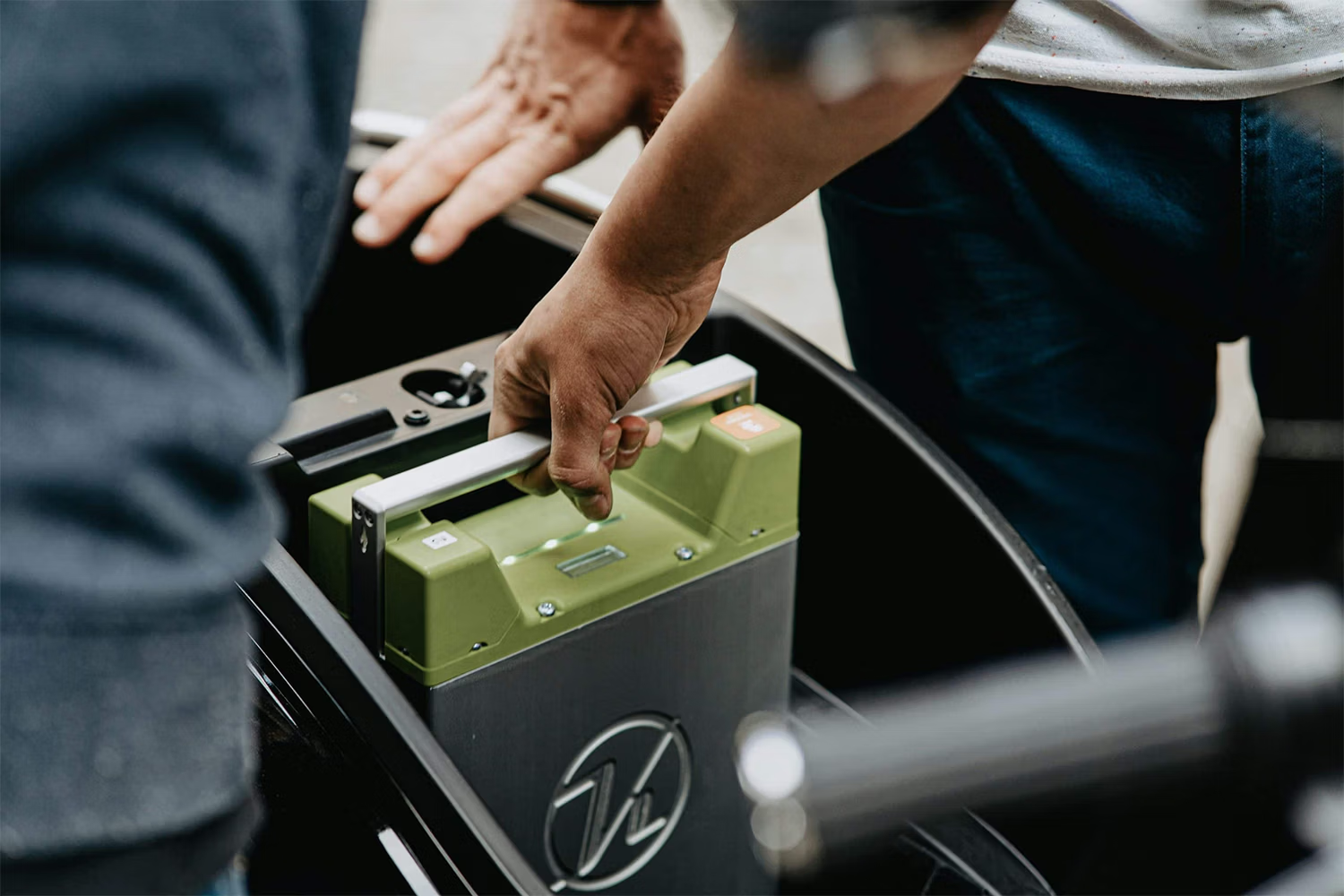
And let’s stay on the battery topic for a little longer. The lithium-ion batteries can represent 30-50% of the BEVs value and are the number one vital component of the vehicle. Between 2015 and 2022 the average battery size increased by 122% which means nowadays the batteries can endure more capacity loss before requiring replacement. Thus the battery life is longer with less need for replacement than before. So even though the life expectancy of batteries nowadays is longer than in the early days of BEVs, it is still hard to say 100% exactly how long the battery will last. The BEVs have not been around long enough to answer that surely and as almost 50% of the BEVs in operation were sold in the past two years, the real level of degradation data is simply not available yet. However, the manufacturers provide a guarantee of at least eight years or 100,000 miles.
A study examining ~ 15,000 BEVs from early models to newer ones released in 2023 revealed that battery replacements due to failure have been uncommon, averaging 2.5%, excluding large-scale recalls. Since modern BEVs were introduced in 2010, the battery technology advanced and has significantly improved reliability. Models produced since 2016, showed even lower failure rate of below 0.5%. Moreover, the majority of these battery replacements would have been covered under the manufacturer’s warranty. 6
Another battery related criticism which might appear is “what happens with the batteries after their capacity stops being sufficient for the BEV car operation”? Even if the car industry might expect the batteries outlast the cars they are in, it is good to think what will happen next. An BEV battery reaches its end of life when its capacity decreases by 20-30% from its original level. However the fact that it is not suitable for an EV operation, does not mean it cannot serve other purpose. And BEV batteries being a resource-intensive component it is important to consider is repurposing opportunities. One of the promising use cases is using them in large-scale energy storage systems which can store excess energy for later use. Similar projects are being deployed already, one example is B2U Storage solutions who is giving second life to more than 1000 BEV batteries from Honda and Nissan and considering deploying battery pack of other brands. 7 Nevertheless even usefully repurposed batteries will reach its final day, so the next logical step is recycling. Despite the fact that up to 80% of battery components are recyclable, recycling can only offset 10% of the materials needed by 2024, projections say. That is why it is crucial to speed up the battery recycling industry to reach its true potential. 8 And the legislation might help with that as the EU is making battery manufacturers responsible for the handling of the battery at the end of its life according to environmental standards.
Recently the Mercedes-Benz factory opened Europe’s first integrated battery recycling facility in Kuppenheim, Germany which, thanks to its innovative process, achieves a 96% recovery rate of valuable materials.
“The facility is designed to process 2,500 tonnes of batteries annually, producing enough recycled materials to manufacture modules for over 50,000 new EVs. This innovative technology enables us to recover valuable raw materials from the battery with the highest possible degree of purity,” said Jörg Burzer, Board Member responsible for Production at Mercedes-Benz Group AG. 9
The facility is mechanically separating the components of the battery and with further hydrometalurgical treatment, the active materials with the precious metals (such as cobalt, nickel and lithium) are then refined for use in new Mercedes-Benz cars. Besides the components separation, within the initiative an extensive stationary storage applications have been developed to repurpose the batteries which are no longer fit for use in the cars. The facility is running on 100% green electricity and is net carbon neutral. The Mercedes-Benz AG is cooperating with three German universities with support of the Federal Ministry of Economic Affairs and Climate action. This particualr use case can be seen as a model example from a complex sustainability plan perspective, incorporating “value retention, closed-loop material systems and circular design concepts”. All within achieving a profitable business model.
Electricity source
Some of us might point out, that the BEV drives as green as the source of its electricity. When the battery is charged from the grid where electricity is supplied from a coal power plant, that impacts the environment more than charging it from solar or wind. MIT’s report conducted a study where they counted with the average carbon intensity of the U.S. power grid and found that a fully electric vehicle produces around 25% fewer carbon emissions than a comparable hybrid. But in Washington state, where hydropower dominates, the EVs emitted 61% less carbon than the hybrid cars. On the other hand, in coal-dependent West Virginia, the BEV generated more carbon emissions than the hybrid, although it still outperformed a gasoline-powered car. 10
In conclusion, the debate over the sustainability of BEVs is more nuanced than it might seem at first glance. A thorough look at lifecycle emissions shows that BEVs can significantly reduce carbon footprints compared to gasoline-powered vehicles. Moreover, advancements in battery technology, repurposing, and recycling, along with shifts toward renewable energy sources, are only enhancing their positive impact. As the industry continues to innovate, BEVs stand as a promising solution to global transportation emissions.

Sources:
1. Environmental Protection Agency
2. IOP Science
3. Carbon Brief
4. Green Energy Consumers Alliance
8. Canary Media
Image credits:
1. Photo by Danis Lou on Unsplash
2. Photo by Florian Cordier on Unsplash
3. Photo by Kumpan Electric by Unsplash
.svg)


